
Click here for the synopsis.
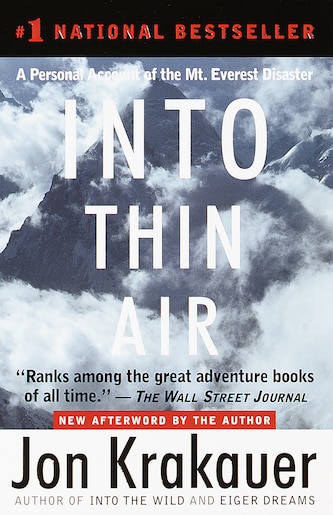
The fascinating thing about literature– you see– is how a story and its message can change depending on what perspective you take while reading it. For instance, my first blog post about Into Thin Air (by Jon Krakauer) was an analysis of the story after I had read it from the reader response perspective. In it, I discussed the happenings in the novel by connecting it to my own experiences. However, in my second post I discussed the story from an archetypal perspective with a focus on character archetypes. I will be doing that again in this post, except this time I will be focusing on a situational archetype.
A short review on archetypes for those interested here.

When analyzing the book from an archetypal perspective, it quickly becomes apparent that the situational archetype ‘the fall’ permeates every aspect of this story. (The definition of ‘the fall’ can be found here). For a character, or characters, to experience ‘the fall’, they must pass through three main phases. The first phase is when the character(s) make a choice/transgression; this results in phase two, in which a punishment is handed down to the character(s) due to their choice/transgression; and phase three is the suffering experienced as a result of this punishment which may or may not lead to redemption.
Now that we’ve gotten that out of the way, I can tell you why I think that ‘the fall’ is such an important part of this story. This archetype is exhibited by all of the central characters in this novel, and through the story of their fall, readers are warned about the consequences of hubris and trying to tame something as powerful and unpredictable as nature.
Now, this may seem like a leap in logic on my part, so let’s go through why I think this is what the author was trying to convey. First we need to know what the choice/transgression that these characters made was; there are actually a few so just bear with me.

A pretty common choice in the stories that follow this archetype is excessive shows of hubris. Which (surprise, surprise) also shows up in Into Thin Air. Some lines that demonstrate this are: “Hubris probably had something to do with it. Hall had become so adept at running climbers…up and down Everest that he got a little cocky…He’d bragged on more than one occasion that he could get almost any reasonably fit person to the summit,” (Krakauer 284), “I began to look down my nose at the world’s tallest mountain…referred to the Southeast ridge as the ‘Yak Route.'” (23), “People of a certain age remember vividly to this day when…they heard the magical news that the summit of the world was, so to speak, theirs.” (21). All of these quotes are examples of hubris from many different characters. This isn’t even the main transgression. The choice that all of the characters make, that leads to their fall, is to contribute to the commercialization of Everest. They all chose to be a part of “thirty distinct expeditions…on the flanks of Everest”, specifically, they were members of the “ten of them organized as money-making venues” (8). It is these choices that eventually lead to the characters’ punishment and fall.

Now that we’ve established that the characters of Into Thin Air pass through phase one, we can move on to their punishment. This comes in the form of a massive storm that hits right as they reach the summit. This sudden and drastic change in weather leaves many characters lost and stranded near the top of the mountain, with no way to get to safety but to blindly wander and hope that they make it back; “Because the wind had erased the tracks of the climbers who’d gone down before me, I had difficulty determining the correct route” (199), “by 6:00 P.M., as the storm escalated into a full-scale blizzard with driving snow and winds gusting in excess of 60 knots” (200), “For the next two hours, Beidleman, Groom, the two Sherpas, and the seven clients staggered blindly around in the storm, growing ever more exhausted and hypothermic, hoping to blunder across the camp.” (215). This is phase two, their punishment for the choices they had made. This directly leads them into phase three: their suffering and/or redemption.

Phase three is different for every character, for some it’s death, others it’s debilitating injuries, a couple suffer blame and judgment from society, and a few are redeemed in the form of immortalization on the mountain. There are way too many characters for me to discuss each, so I’ll only give a brief description of a few. If you want to know more, I’d recommend reading the book. Overall “Everest killed twelve men and women” (283) throughout the course of the novel. Some, such as Hall, were immortalized where he lay on the mountain– which is a form of redemption for someone who spent his whole life climbing. Others, such as Beck Weathers, survived but were left with crippling injuries resulting in him having “his right arm amputated…All four fingers and the thumb on his left hand…removed. His nose…amputated” (295). Some people made it out with little injury but instead became “a lightning rod for a great deal of public anger over what had happened on Everest” (300). Every character in the book faces some form of suffering due to their punishment; few are redeemed but don’t live to see it.

As you can see, each character in the book experiences ‘the fall’ archetype at one point or another. Everyone, main character included, passes through all three phases- although some certainly fall harder than others. Through their experiences, readers should learn the deadly ramifications of hubris and thinking that something like nature can be tamed.
Book Reference:
Krakauer, Jon. Into Thin Air. New York, Anchor Books, November 1999. Print.
Website References:
Editing-Queen. “Top 11 Examples of Archetypes in Literature.” ServiceScape, ServiceScape Incorporated, 9 July 2018, www.servicescape.com/blog/top-11-examples-of-archetypes-in-literature.
Woods, Arleen. “Archetypes The Models of Our Entertainment and Philosophies.” SlidePlayer, 2016, slideplayer.com/slide/9954307/.
Picture References:
Baiz, Allison. “Greyscale Above Photography of Man Falling Down.” Pexels. N/a. https://www.pexels.com/photo/grayscale-above-photography-of-man-falling-down-883347/
Cunningham, Caroline. “Into Thin Air: A Personal Account of the Mt. Everest Disaster.” Indigo. N/a. https://www.chapters.indigo.ca/en-ca/books/into-thin-air-a-personal/9780385494786-item.html
Mahatma4711. “Expeditions at Mt. Everest Base Camp, April 2006.” flickr. April 27, 2006. https://www.flickr.com/photos/india-nepal-iran/215827006
MatiasEnElMundo. “Icarus greek myth stock illustration.” iStock. May 11, 2019. https://www.istockphoto.com/ca/vector/icarus-greek-myth-gm957606438-261485120
Ryan, Jerome. “11 Memorial Chortens Next To Gorak Shep For Rob Hall, Doug Hansen, Andy Harris, Yasuko Namba, Bruce Herrod.” Mountains Of Travel Photos. N/a. http://www.mountainsoftravelphotos.com/index.html
N/a. “The free high-resolution photo of mountain, snow, winter, mountain range, weather, season, plateau, blizzard, freezing, atmospheric phenomenon, mountainous landforms, geological phenomenon, winter storm.” pxhere. December 31, 2016. https://pxhere.com/en/photo/155555
 Katlin's Blog